

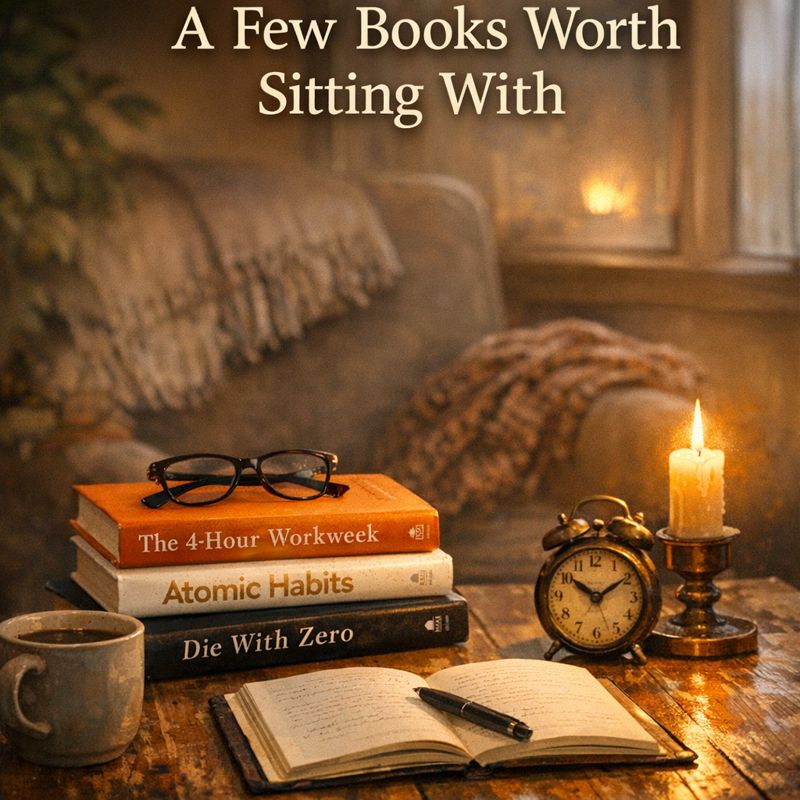
I was thinking recently about how the right books can be influential, but rarely does a single book change everything overnight.
What does happen is that certain books land at the right moment. They don’t necessarily flip a switch, but they gently shift your perspective. Sometime later, you often realise your direction has changed.
There are a few books that books that changed how I think about work and money.
The 4-Hour Work Week
This was the first real crack in the wall.
When I read it years ago, I didn’t quit my job or redesign my life overnight. What it did do was introduce an idea I hadn’t seriously considered before. That work, time, and income don’t have to be permanently tied together.
It made me question assumptions I’d never questioned. About presence, control, and whether “this is just how it is” was actually true.
I’ve written more about my thoughts on it here if you’re curious: The 4-Hour Workweek
Although this book didn’t give me all of the answers, it gave me permission to think differently.
Atomic Habits
Atomic Habits explained something I’d got wrong for years.
I used to believe progress came from motivation or big decisions. This book reframed that. Real change comes from systems. For me, that was small, repeatable habits that compound over time.
That shift changed how I approach learning, money, fitness, and building things online. I stopped chasing dramatic resets and focused on what I could actually sustain.
It taught that taking small consistent actions daily gets massive results over time.
Die With Zero
This one landed later and hit closer to home.
Die With Zero challenges the idea that maximising safety should always come first. It highlights the hidden cost of constantly deferring life in the name of “later”.
I didn’t take it as a call to be reckless. I took it as a reminder to be intentional. About time. About energy. About not endlessly postponing things that matter.
It reinforced something I already suspected. That the point isn’t just accumulation. It’s balance.
The common thread
None of these books handed me a formula or a step-by-step plan.
What they did was quietly reshape how I think about work and money. And once your thinking shifts, your decisions tend to follow.
If you’re in a phase of reassessing things, these are books worth sitting with rather than rushing through.


